The Geometry of High Dimensions
How objects behave in High Dimensions
Have you ever wondered what a higher-dimensional object looks like?
I certainly did. But I could not even imagine what such an object might look like. It felt impossible to visualize. That changed when I came across the book Foundations of Data Science by Avrim Blum, where the geometry of high dimensions is explained in a very intuitive way.
Let us start with something simple.
Consider a cube with side length (s). We naturally think of it as a three-dimensional object.
Now suppose we project this cube into two dimensions. What do we get? A square with side length (s).
What if we project it into one dimension? Then it becomes a straight line segment of length (s).
So in different dimensions we see:
- 3D → cube
- 2D → square
- 1D → line segment
The important observation is that in every case the side length remains (s). A cube can therefore be thought of as an object whose side length is (s) in every dimension.
Keeping this idea in mind, we can move forward.
What happens to the volume of a cube in (d) dimensions if the side shrinks by a factor of ?
This question gives us one of the first glimpses into the geometry of high dimensions and helps explain why we often hear the phrase “curse of dimensionality.”
For a (d)-dimensional cube with side length (s), the volume is
Now suppose the side length shrinks by a factor of .
The new side length becomes
The new volume is therefore
As the dimension (d) increases, the term ((1-\epsilon)^d) rapidly approaches zero.
This means
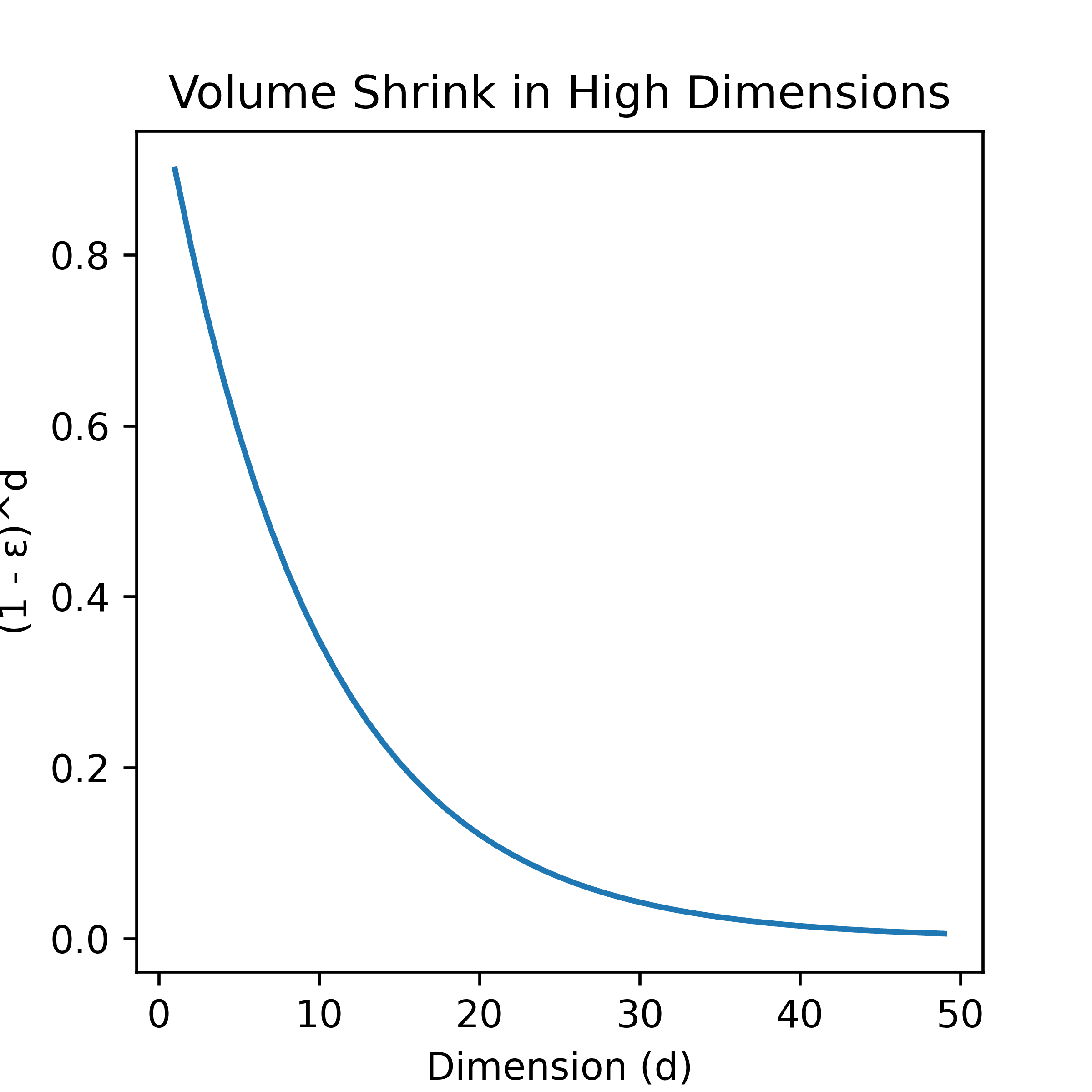
Let us pause and think about what this means.
By shrinking the side length slightly in every dimension, the volume decreases extremely quickly as the number of dimensions grows.
This has a surprising implication.
In the three-dimensional world we live in, the volume of an object is spread throughout the object. The interior of the object contains most of the volume.
But in very high dimensions something different happens.
If removing a thin layer from the surface causes the volume to drop almost to zero, then most of the volume must already be located near the surface.
In other words:
In high dimensions, the volume of an object is concentrated near its surface.
In the book Foundations of Data Science, the authors demonstrate this phenomenon using spheres and show that most of the mass of a high-dimensional sphere lies close to its surface rather than near its center.